
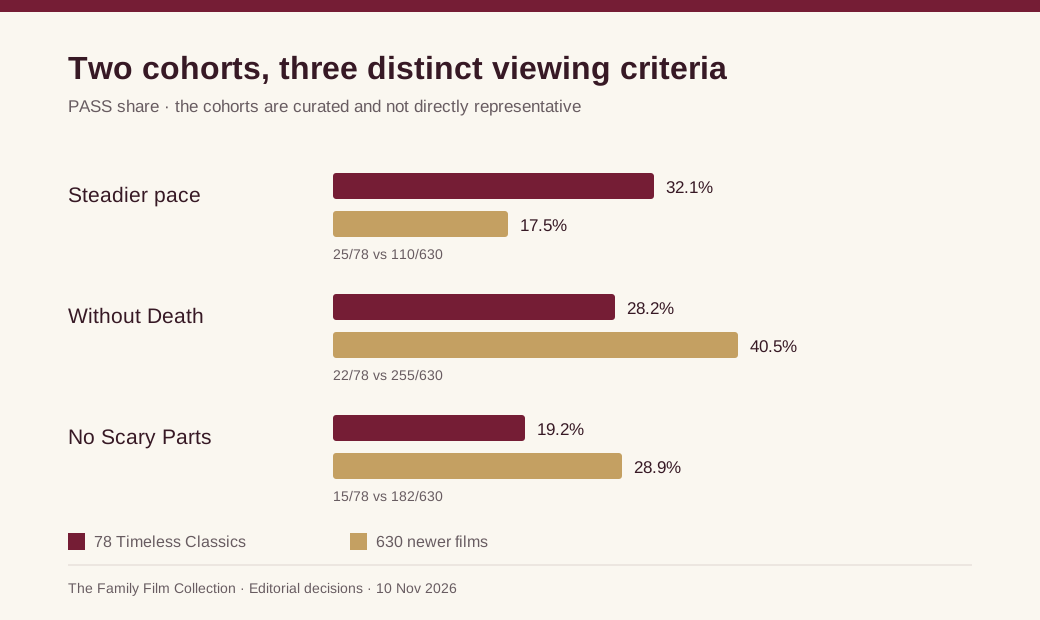
Current update — 10 November 2026. Within the two fixed comparison groups of 78 Timeless Classics and 630 newer released films, 25/78 (32.1%) versus 110/630 (17.5%) currently qualify for Films with a Steadier Pace. For Movies Without Death the counts are 22/78 (28.2%) versus 255/630 (40.5%), and for Movies Without Scary Parts 15/78 (19.2%) versus 182/630 (28.9%). The comparisons refer to different editorial criteria and non-equivalent curated cohorts; they do not establish that films from one era are generally less intense. The pacing selection is qualitative, not a sensory measurement.
Earlier research text — historical snapshots only
Historical source — recorded 30 September / updated through 26 October 2026
Were Older Family Movies Really Less Intense?
Current research update — 26 October 2026 (Production Master V25). The fixed cohorts remain 78 Timeless Classics and 630 modern released films. Current PASS decisions, classics versus modern: Low Sensory 25/78 (32.1%) versus 113/630 (17.9%); Without Death 22/78 (28.2%) versus 255/630 (40.5%); No Scary Parts 15/78 (19.2%) versus 182/630 (28.9%). The criteria produce different patterns; they do not support a blanket claim that older family movies are less intense.
Historical research update — 15 October 2026 (Production Master R3). The cohorts remain 78 Timeless Classics and 630 modern released films. PASS decisions at that date among classics versus modern: Low Sensory 25/78 (32.1%) versus 113/630 (17.9%); Without Death 22/78 (28.2%) versus 257/630 (40.8%); No Scary Parts 15/78 (19.2%) versus 183/630 (29.0%). The modern Low Sensory group also has 50 reviewed NOT_SELECTED records. The criteria yield different answers; no blanket claim that older movies are gentler is supported. The earlier 10 October and 30 September figures below represent prior classification snapshots.
Previous version and original frozen research — historical snapshots
Research update — 10 October 2026. The historical set is still 78 Timeless Classics; the modern comparison now contains 630 released films. Under the current decisions, verified Low Sensory PASS is 28/78 (35.9%) for classics versus 121/630 (19.2%) for modern films; 59 modern titles remain unclassified for this rule. For Without Death, the figures are 27/78 (34.6%) versus 271/630 (43.0%), with 82 modern decisions missing. For No Scary Parts: 21/78 (26.9%) versus 136/630 (21.6%), with 82 modern decisions missing. These modern rates are confirmed minima. The original 47/246 Low Sensory results below belong to an earlier classification snapshot; the two sets must not be treated as directly comparable.
The answer depends on which kind of intensity we mean. In TFFC’s data, 1980–1999 Timeless Classics are more likely than the 2010–2026 comparison group to pass Low Sensory — 60.3% versus 44.9%. But they are less likely to qualify for Movies Without Death, and the No Scary Parts rate is almost the same.
Nostalgia can compress several qualities into one feeling. An older family film may seem less visually busy, less frantic or more familiar, and that memory can become a broader belief that older films contained fewer difficult moments.
TFFC’s viewing-need data allows those ideas to be separated.
For this analysis, the historical cohort is 78 TFFC Timeless Classics released from 1980–1999. The modern comparison contains 548 released films from 2010–2026.
Older classics are more likely to pass Low Sensory
Among the 78 historical classics, 47 pass Low Sensory — 60.3%.
In the modern comparison group, 246 of 548 pass — 44.9%.
This is the clearest difference in the study. The curated classic cohort is more likely to meet TFFC’s Low Sensory rule.
That can help explain why some remembered favourites feel less busy as a viewing experience. It does not mean every older film is calm or every newer film is sensory-heavy.
Death-free qualification moves in the opposite direction
For Movies Without Death, the historical classics are less likely to qualify.
Only 27 of 78 classics — 34.6% — pass the rule, compared with 275 of 548 modern films — 50.2%.
This matters because “felt calmer” and “contained fewer difficult subjects” are not the same claim. A film can have a restrained sensory profile while still including grief, loss or death-related material.
The nostalgia story becomes less convincing when those dimensions are collapsed together.
No Scary Parts is almost unchanged
The No Scary Parts result is much closer:
- Historical classics: 21/78 = 26.9%.
- Modern films: 140/548 = 25.5%.
A difference of 1.4 percentage points does not support a broad claim that the classic cohort is dramatically more likely to be free of scary material under this rule.
“Less intense” is not one variable
The three measures point in different directions:
- sensory profile: classics pass at a higher rate;
- complete qualifying death absence: modern films pass at a higher rate;
- no scary parts: very similar.
So there is no single database field that can validate “older family movies were less intense” as a universal statement.
The better interpretation is more specific: the nostalgic impression of older favourites maps more clearly to sensory profile than to complete absence of difficult material.
The cohort itself matters
The historical group is not every family film released from 1980–1999. It is TFFC’s curated Timeless Classics collection within those years.
That makes it a useful nostalgia cohort, but also a selected one. Films remembered and curated as classics may differ from the full output of their era.
The modern comparison, by contrast, contains the much broader released 2010–2026 catalogue. The study should therefore be read as a comparison between these two defined TFFC groups, not as a market-wide historical census.
At a glance
Timeless Classics 1980–1999: 78 films
Modern released comparison 2010–2026: 548 films
- Low Sensory PASS: 60.3% vs 44.9%.
- Movies Without Death PASS: 34.6% vs 50.2%.
- No Scary Parts PASS: 26.9% vs 25.5%.
How we measured this
Dataset: The Family Film Collection production database, frozen 30 September 2026.
Historical cohort: 78 films in TFFC’s Timeless Classics collection, released 1980–1999.
Modern cohort: 548 released TFFC films, 2010–2026 through the freeze date.
Method: Compare PASS rates for Low Sensory, Movies Without Death and No Scary Parts.
Limitation: The historical cohort is curated and selected. Non-PASS is not converted into positive prevalence, and no unpublished composite intensity score is used.
Continue exploring
- Why a Film with a Steadier Pace Can Still Be for Older Kids (R07)
- How Much Does Your Family Movie Shortlist Shrink When You Want a Gentler Story? (R18)
- How TFFC's Steadier-Pace Selections Vary Across Decades (R22)
- Timeless Classics


