
Current update — 10 November 2026. In the current released catalogue, 60 films qualify for Films with a Steadier Pace, Movies Without Scary Parts and Low-Conflict Movies for Kids together. 37 also meet both Movies Without Parent Death and Movies Without Animal Death; 33 additionally meet Movies Without Death. These are nested counts of current editorial PASS decisions, not a prevalence trend or a technical sensory assessment. Flashing and strobe effects were not assessed for Films with a Steadier Pace.
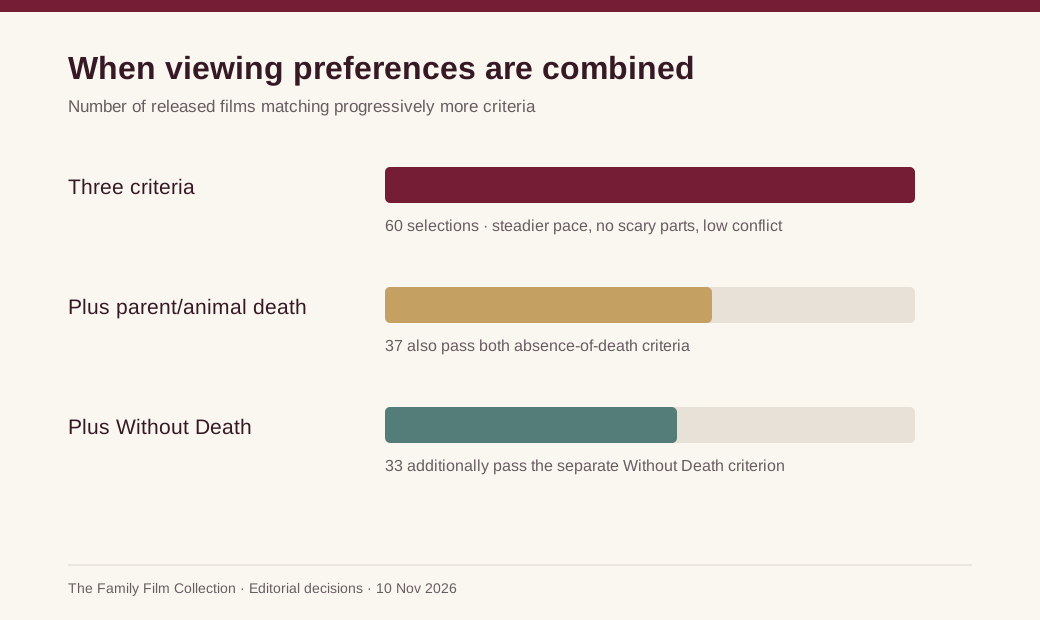
Families can combine the filters that matter to them and build a shortlist around their own preferences. A calm movie can mean something different to every viewer.
Earlier research text — historical snapshots only
Historical source — recorded 30 September / updated through 26 October 2026
How Rare Is a Family Movie That Is Low-Sensory, Low-Conflict and Not Scary?
Current research update — 15 October 2026 (Production Master R3). Among 1,229 released films, 61 titles currently have PASS decisions for Low Sensory, No Scary Parts and Low Conflict together. 38 of those also pass both Without Parent Death and Without Animal Death; 33 additionally pass Without Death. These are counts of confirmed memberships under the latest rules, not prevalence estimates or evidence of a change in film content over time. Earlier 10 October counts (49/36/30) and the 30 September cohort (81/69/58) are archived snapshots below.
Previous version and original frozen research — historical snapshots
Research update — 10 October 2026. The current 1,229-film released catalogue contains 49 currently verified three-rule PASS titles, narrowing to 36 when both parent-death and animal-death absence are also required, and to 30 when the No Qualifying Death rule is added. The 141 newly added films have not yet received the full No Scary Parts/Low Conflict decisions, so these are confirmed counts, not final catalogue-wide prevalence estimates. The 81/69/58 results below belong to the original 30 September 2026 data freeze and must not be compared as a decline.
Only 81 of 1,088 released TFFC films — 7.4% — pass Low Sensory, No Scary Parts and Low Conflict together. Add stricter death-related viewing needs and the set narrows further.
A single filter can return a substantial part of a catalogue. Stack several specific viewing needs, and the result changes quickly.
That is the question behind this study: how large is the overlap between three TFFC rules that families may combine when they want a calmer movie night?
The answer is 81 films.
Three filters, fewer shared choices
The analysis uses three current viewing-need decisions:
- Low Sensory
- No Scary Parts
- Low Conflict
Across the 1,088 films released by 30 September 2026, 81 pass all three. That is 7.4% of the released catalogue.
The number is useful because the three labels describe different dimensions. A film can be low sensory while carrying strong conflict. It can avoid scary material and still be loud or frenetic. It can keep conflict low while containing a frightening sequence.
The overlap is therefore far smaller than any one filter on its own.
Add death-related filters and the set narrows again
Among the same released catalogue:
- 69 films — 6.3% — pass the three-rule calm profile and qualify for both No Parent Death and No Animal Death.
- 58 films — 5.3% — pass the three-rule calm profile and qualify for No Qualifying Death.
Each added filter narrows the choices. None of them is an intensity score.
A family that cares about one of these issues can add the relevant rule. A family that does not need it should not lose films from the result merely because another household would filter differently.
Why TFFC does not call the 81 “low-intensity films”
The 81-film group is restrained in three defined ways. That still does not describe the entire viewing experience.
A title can pass all three and still contain difficult ideas, loss, historical context, demanding dialogue, moral ambiguity, family separation or a story that works better for an older viewer.
That is why TFFC keeps age guidance, content notes and viewing-need qualifications as separate layers.
A transparent filter should tell you what it screened for — and stop there.
The result also explains why broad recommendations can fail
“Give me something calm” sounds like one request. In practice, it can contain several different requests:
- not visually or sonically dense
- no material likely to qualify as scary
- little interpersonal or external conflict
- no parent death
- no animal death
- no qualifying death at all
Once those needs are separated, a discovery system can respond more precisely.
The 7.4% result shows why that precision matters. A broad family-film catalogue can become a small shortlist when several constraints are combined.
What this does — and does not — mean
This is not a prevalence study of every family film ever released. It describes the released TFFC catalogue under TFFC’s current rules.
It also does not mean the remaining 92.6% are unsuitable for sensitive viewers. They fail at least one of three specific filters; that may be irrelevant to a particular family.
The aim is to help each family find the films they are looking for more easily, not to rank the rest by quality.
At a glance
- Released catalogue: 1,088 films.
- Low Sensory + No Scary Parts + Low Conflict: 81 = 7.4%.
- Plus No Parent Death + No Animal Death: 69 = 6.3%.
- Plus No Qualifying Death: 58 = 5.3%.
How we measured this
Dataset: The Family Film Collection production database, frozen 30 September 2026.
Films examined: 1,088 released films.
Method: Intersection of current approved PASS decisions.
Important limitation: The 81-film set is not labeled “truly low-intensity” because these rules do not cover every possible content, thematic or maturity dimension.
Continue exploring
- Why a Film with a Steadier Pace Can Still Be for Older Kids (R07)
- What Does “Low-Stimulation TV” Actually Mean? (R17)
- What Makes a Good First Full-Length Movie? (R20)
- How TFFC's Steadier-Pace Selections Vary Across Decades (R22)


