
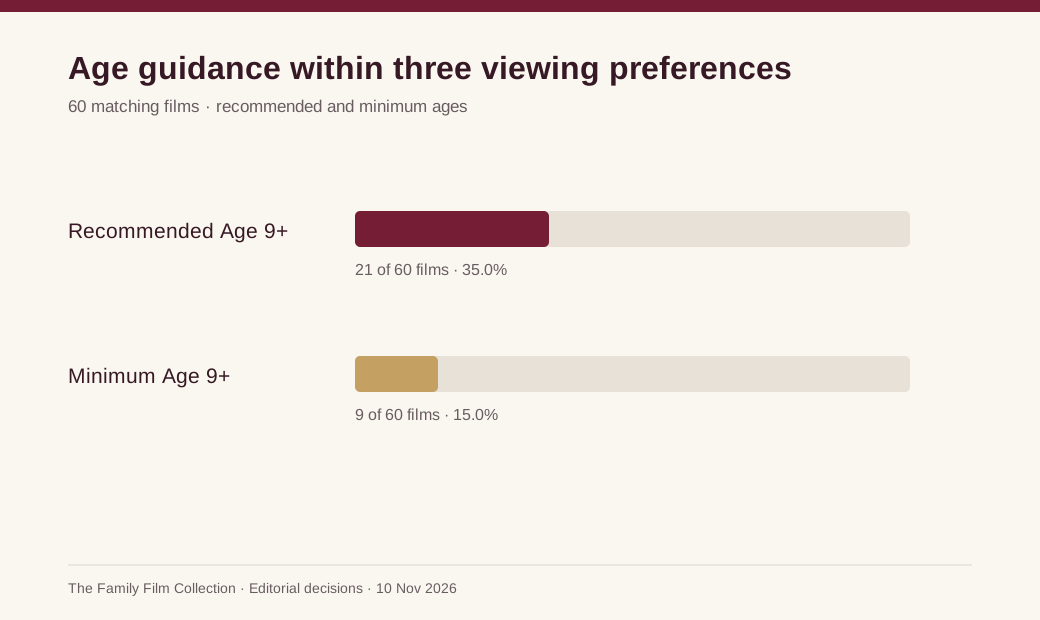
Current update — 10 November 2026. In the current catalogue, 60 released films meet all three of these viewing preferences, each judged on its own: Films with a Steadier Pace, Movies Without Scary Parts, and Low-Conflict Movies for Kids. 21/60 (35.0%) have Recommended Age 9+, and 9/60 (15.0%) have Minimum Age 9+. A film selected for a more measured rhythm may still address themes or relationships better suited to older viewers. The pacing criterion is based on qualitative editorial notes; it is not a measurement of audio intensity or flashing lights.
What to take from this: use age guidance together with the three filters. A match on pacing, scares and conflict does not replace age suitability.
Earlier research text — historical snapshots only
Historical source — recorded 15 October 2026
Why a Calm Family Movie Can Still Be for Older Kids
Among 61 currently verified TFFC films that pass Low Sensory, No Scary Parts and Low Conflict together, 21 — 34.4% — still have a Recommended Age of 9 or above.
A calm viewing profile answers only part of the age question.
A film can avoid strong sensory load. It can avoid material that counts as scary under TFFC’s rule. It can keep conflict comparatively low. None of those facts automatically makes its story, ideas or structure suitable for a very young viewer.
That difference is visible in the data.
The controlled cohort
TFFC identified 61 currently verified released films that pass all three of these viewing-need rules:
- Low Sensory
- No Scary Parts
- Low Conflict
Within that group, 21 films have a Recommended Age of 9+. That is 34.4% of the cohort.
Using the stricter Minimum Age threshold, 9 of the 61 films — 14.8% — are 9+.
The result is useful because it strips away a common shortcut: “calm” and “young” are not interchangeable labels.
Three calm dimensions do not describe the whole film
Low Sensory, No Scary Parts and Low Conflict are practical filters. Each one addresses a specific viewing concern.
They do not measure every feature that can affect age suitability.
An older-viewer recommendation can reflect narrative density, historical or cultural context, abstract ideas, irony, grief, moral ambiguity, slower story construction, complex relationships or material that requires more background knowledge. A film can be restrained in sound, motion, threat and confrontation while still asking a great deal from the viewer.
This is why TFFC keeps age guidance separate from viewing-need qualifications.
Recommended Age and Minimum Age do different work
The two thresholds also explain why the result changes depending on which age field is used.
A Minimum Age marks the lower boundary at which TFFC considers the film potentially workable with the right context. A Recommended Age is the age at which the film is more likely to land as intended overall.
In this 61-film group, 14.8% are Minimum Age 9+, but 34.4% are Recommended Age 9+.
That gap is not a contradiction. It reflects the difference between “could work from here” and “best fit from here.”
Why this matters for filters
Viewing-need filters are most useful when they narrow one dimension without pretending to answer every other one.
A family looking specifically for low conflict should be able to find that. A viewer who wants to avoid scare-focused material should be able to filter for it. A sensory-sensitive household should be able to start from a Low Sensory set.
But the final choice still benefits from checking the film’s age guidance and content notes.
That is especially true when several filters are stacked. The resulting set may feel calmer in presentation while containing stories intended for older viewers.
What this does — and does not — mean
The finding does not mean that one third of films in this verified cohort are “too mature.” It does not identify one single reason each title has an older Recommended Age.
It shows something narrower: in a controlled TFFC cohort defined by three calm-viewing rules, a substantial minority still sits at Recommended Age 9+.
The practical conclusion is straightforward: use calm-viewing filters and age guidance together.
At a glance
- Calm-viewing cohort: 61 films.
- Recommended Age 9+: 21/61 = 34.4%.
- Minimum Age 9+: 9/61 = 14.8%.
How we measured this
Dataset: The Family Film Collection production database, with a snapshot of current approved decisions dated 15 October 2026.
Films examined: Released films passing all three TFFC rules: Low Sensory, No Scary Parts and Low Conflict.
Method: The 61-film current-PASS intersection was compared with TFFC Recommended Age and Minimum Age fields.
Exclusion: No unpublished composite intensity score was used to derive the age result.
Update note: This 15 October figure is the intersection of currently approved PASS decisions in the production master, not a change attributed to the 141 newly added films. The 30 September media-kit cohort of 81 remains the historical baseline; the two snapshots should not be treated as a time trend. Films without a current PASS on all three rules are outside this verified intersection.
Continue exploring
- How Much Does Your Family Movie Shortlist Shrink When You Want a Gentler Story? (R18)
- What Makes a Good First Full-Length Movie? (R20)
- How TFFC's Steadier-Pace Selections Vary Across Decades (R22)
- Low Sensory
- No Scary Parts
- Low Conflict


