
Current update — 10 November 2026. In the fixed 1,090-film TFFC cohort released from 1980 to 2025, current decisions for Films with a Steadier Pace comprise 218 PASS, 798 EXCLUDE, 70 NOT_SELECTED and 4 BORDERLINE. The PASS shares by period are 20/95 (21.1%) in the 1980s, 40/147 (27.2%) in the 1990s, 48/235 (20.4%) in the 2000s, 82/368 (22.3%) in the 2010s, and 28/245 (11.4%) in 2020–2025. These are shares of TFFC's editorial selection in a particular catalogue, not measured levels of sensory stimulation or a claim about the entire industry. The pattern is not a decline in every successive period.
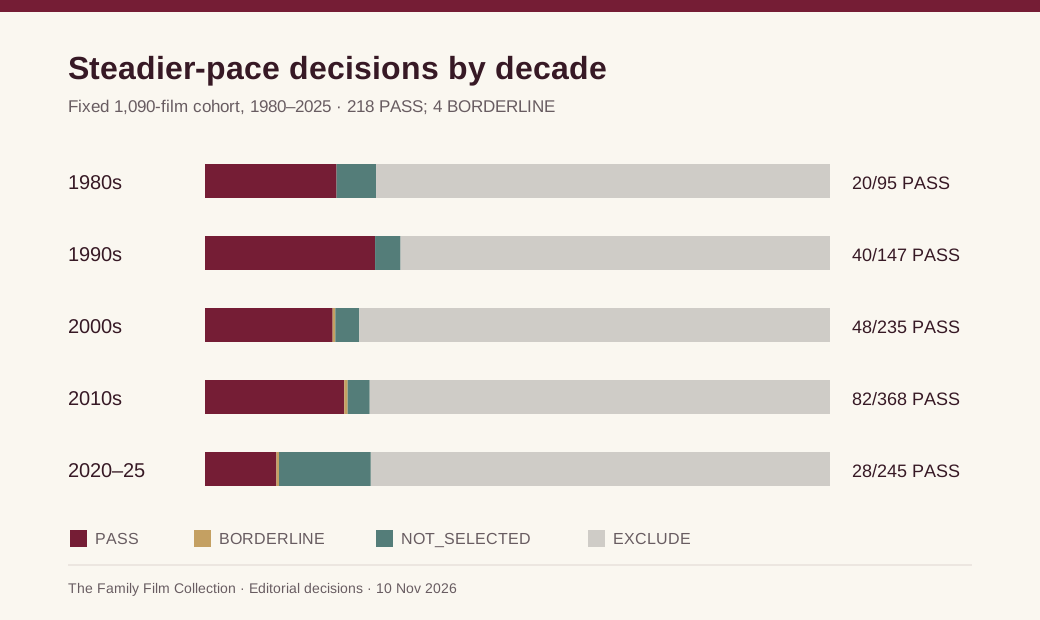
The category now describes a relatively steady narrative pace, informed by qualitative notes about editing, music and sound. It is not a clinical or technical assessment. Earlier Low Sensory figures below describe previous classification versions and are historical, not directly comparable trend points.
Earlier research text — historical snapshots only
Historical source — recorded 30 September / updated through 26 October 2026
Are Low-Sensory Family Movies Becoming Less Common?
Current research update — 15 October 2026 (Production Master R3). In the same 1,090 released films from 1980–2025, there are 222 current Low Sensory PASS decisions, 798 EXCLUDE decisions, and 70 reviewed NOT_SELECTED decisions. For the 1990s the confirmed PASS count is 40/147 (27.2%); for 2020–2025 it is 29/245 (11.8%). These are verified classification shares of the current dataset, not a market-wide prevalence study. They must not be read as a direct trend from the original 30 September percentages, because the underlying decisions were revised afterwards. The 10 October figures (240 current PASS; 85 then unclassified) and 30 September figures below are preserved as historical snapshots.
Previous version and original frozen research — historical snapshots
Research update — 10 October 2026. The 1980–2025 released TFFC cohort now contains 1,090 films, with 240 current Low Sensory PASS decisions and 85 unclassified records. For the 1990s, 44/147 (29.9%) have verified current PASS; for 2020–2025, 31/245 (12.7%). These are minimum confirmed shares, not final qualification rates. Even if all 40 unclassified 2020–2025 titles qualified, their share would reach 29.0%, below the 1990s confirmed minimum of 29.9%. Rule decisions have changed since the original freeze, so the 60.9% and 41.8% below are archived September results, not comparable points in an October time series.
Within 973 released TFFC films from 1980–2025, the share passing the Low Sensory rule falls from 60.9% in the 1990s to 41.8% in 2020–2025. The direction is visible in both Live Action and Animation/Hybrid.
The result starts with an editorial rule, not a stopwatch.
TFFC’s Low Sensory classification is designed to identify films with a comparatively restrained sensory profile. It is not based on average shot length, and it is not a clinical measure of stimulation.
Using that rule, the catalogue shows a clear shift across recent decades.
The decade pattern
Among released TFFC films in the study period, Low Sensory PASS is:
- 53.6% in the 1980s
- 60.9% in the 1990s
- 51.1% in the 2000s
- 48.2% in the 2010s
- 41.8% in 2020–2025
The 1990s are the high point in this comparison. The share then declines across each subsequent period.
That makes the direction notable, but it should still be described as a TFFC catalogue trend, not a market census.
The pattern is not only a format-mix effect
One obvious question is whether the result appears because the catalogue contains a different balance of live action and animation in newer decades.
The format check shows that composition is not the whole explanation.
For Live Action, Low Sensory PASS falls from 67.0% in the 1990s to 43.8% in 2020–2025.
For Animation/Hybrid, it falls from 50.0% to 40.4%.
The decline is larger in live action, but both broad format groups move in the same direction.
What this study deliberately does not measure
This article does not measure average shot length or editing speed, so it cannot claim that either caused the Low Sensory trend.
It also does not connect the pattern to children’s attention spans, short-form video, streaming algorithms or any other causal explanation. Those questions require different data.
Why the editorial rule is still useful
A defined category can answer a practical catalogue question without explaining the whole industry.
For a family that actively seeks restrained sensory presentation, the relevant finding is that such films make up a smaller share of TFFC’s newer-decade sample than they did in the 1990s.
That can affect discovery. If the desired profile is less common in the available catalogue, a dedicated filter becomes more valuable.
The result also helps separate two discussions that are frequently mixed together:
- What does the media feel like to watch?
- What does research say that style does to cognition?
R17 addresses the second question. This study addresses the first one inside TFFC’s film data.
What this does — and does not — mean
The analysis supports the statement that Low Sensory qualification is less common in TFFC’s 2020–2025 released sample than in its 1990s sample.
It does not prove that all family cinema became more stimulating, that one production technique caused the change or that higher-sensory films are worse.
Low Sensory is a viewing preference and navigation dimension, not a quality score.
At a glance
- Films examined: 973 released films, 1980–2025.
- 1990s Low Sensory PASS: 60.9%.
- 2020–2025: 41.8%.
- Live Action: 67.0% → 43.8%.
- Animation/Hybrid: 50.0% → 40.4%.
How we measured this
Dataset: The Family Film Collection production database, frozen 30 September 2026.
Films examined: 973 released films from 1980 through 2025.
Method: Share passing the current Low Sensory rule by period, with a broad format robustness check.
Exclusion: No shot-length, editing-speed or attention-span analysis was used.


