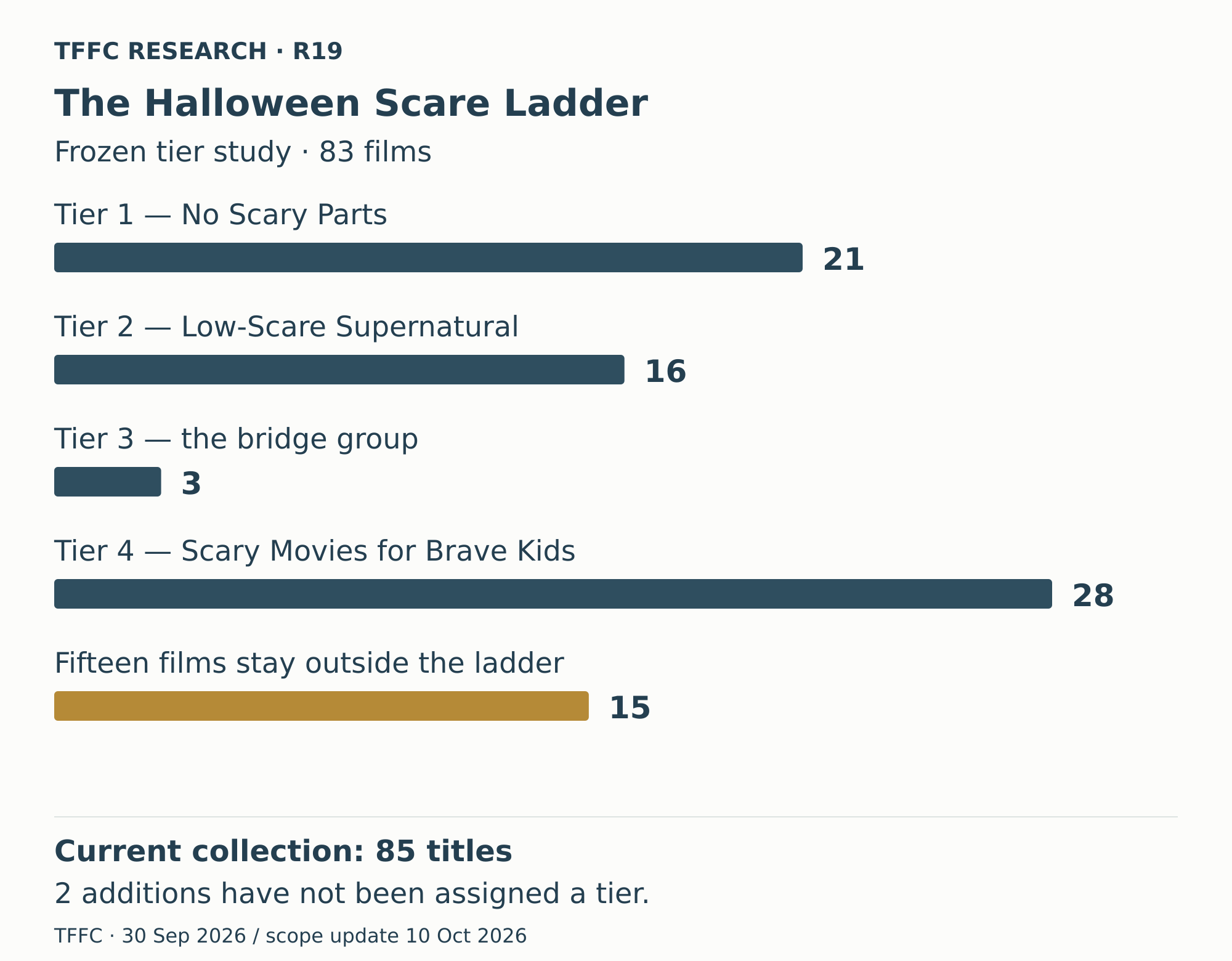
The current TFFC Halloween collection contains 85 titles. The original, fully adjudicated 83-film research set places 68 titles into four scare bands and leaves 15 at the boundary. Two newly added titles have not yet been assigned a scare tier, so the historic tier counts are not rates for all 85 titles.
Halloween viewing is difficult to reduce to one “scariness” number. A supernatural idea can be easy for one viewer and difficult for another. A film can avoid jump scares but still carry disturbing imagery. Another can contain spooky creatures without building sustained fear.
For this reason, TFFC’s Halloween ladder is not an intensity score. It is built from existing viewing-need decisions with clear rules: No Scary Parts, Low-Scare Supernatural, Scary Movies for Brave Kids and No Jump Scares.
The result is a navigation system that sorts most of the Halloween catalogue while leaving genuine boundary cases visible.
Tier 1 — No Scary Parts
21 films qualify for TFFC’s strict No Scary Parts rule.
Their median Recommended Age is 6.
This is the lowest-scare entry point in the ladder. Qualification depends on the collection’s rule, not on a general Halloween label or a numerical intensity score.
A film can still contain Halloween imagery, fantasy creatures, suspenseful ideas or seasonal atmosphere and qualify here if it meets the No Scary Parts rule. Families looking for an October movie without a scare-focused experience can start with this group.
Tier 2 — Low-Scare Supernatural
16 films sit in the Low-Scare Supernatural tier without also qualifying for the Brave Kids group.
Their median Recommended Age is 7.
This tier allows more overtly spooky material while staying within TFFC’s lower-scare supernatural rule. Ghosts, monsters, magic, eerie settings or supernatural ideas may be present, but the films have passed the specific collection standard used for this group.
The category is useful because “contains ghosts” and “is frightening” are not the same statement.
Tier 3 — the bridge group
Only 3 films qualify for both the Low-Scare Supernatural and Scary Movies for Brave Kids rules.
Their median Recommended Age is 7.
This small crossover is important. It shows why the ladder is not a clean scientific scale. Editorial rules can overlap at the edges, and the overlap itself carries information.
These titles can work as a bridge for families moving from lower-scare seasonal viewing toward stronger material, with the individual film page still providing the necessary context.
Tier 4 — Scary Movies for Brave Kids
28 films qualify for Scary Movies for Brave Kids without qualifying for the lower-scare supernatural tier.
Their median Recommended Age is 9.
This group is intended for viewers seeking a stronger Halloween experience within the family catalogue. The age figure describes the middle of this TFFC subset. It is not a promise that every nine-year-old will find every film comfortable.
Film-specific content notes are important because fear is not one-dimensional. Threat, creature design, sustained suspense, grief, violence and atmosphere can create very different experiences when two films occupy the same broad tier.
Fifteen films stay outside the ladder
15 of the 83 films are boundary titles that require film-level guidance.
Their median Recommended Age is 8.
TFFC does not force these films into a band merely to achieve complete coverage. A boundary result can be more useful than false precision. Families can open the individual film page and use its age guidance, content notes and related viewing-need qualifications directly.
That is a deliberate part of the method, not missing data.
Jump scares are a separate question
31 of the 83 Halloween films qualify for TFFC’s No Jump Scares rule.
This does not create a fifth ladder tier.
Jump scares describe one mechanism. A film can avoid sudden startle moments and still be frightening through imagery, suspense or subject matter. A film can also contain a startle moment without belonging to the strongest overall scare group.
For that reason, No Jump Scares works best as an overlay across the ladder. Families who care specifically about sudden scares can apply it on top of the broader tier that suits them.
What this does — and does not — mean
The Halloween Scare Ladder organizes the TFFC Halloween catalogue using transparent existing rules. It does not claim to measure fear biologically, predict an individual child’s response or turn scariness into a universal score.
The ladder uses only the viewing-need rules described above. It does not rely on an unpublished composite intensity score. Uncertainty stays visible where those rules do not produce a clean assignment.
At a glance
- Halloween titles in the current collection: 85; original tier study: 83.
- Tier 1 — No Scary Parts: 21, median Recommended Age 6.
- Tier 2 — Low-Scare Supernatural: 16, median 7.
- Tier 3 — Bridge/crossover: 3, median 7.
- Tier 4 — Scary Movies for Brave Kids: 28, median 9.
- Boundary / film-level guidance: 15, median 8.
- No Jump Scares PASS: 31, used as an overlay.
How we measured this
Scope update (10 October 2026): COLL-237 contains 85 mapped titles. The 83-title tiers, medians and No Jump Scares statistics are the frozen 30 September study; the two added films are FFC-1093 (Under Wraps 2) and FFC-1094 (Twitches Too) and remain uncoded for these tiers. Do not calculate 2026 tier percentages using a denominator of 85 until both are adjudicated.
Dataset: The Family Film Collection production database, frozen 30 September 2026.
Films examined (frozen tier study): 83 Halloween films adjudicated on 30 September 2026; see 85-title current scope above.
Primary rules: Current viewing-need decisions for No Scary Parts, Low-Scare Supernatural and Scary Movies for Brave Kids.
Overlay: No Jump Scares.
Boundary policy: Films without a clean tier assignment remain boundary titles and keep film-level guidance.
Exclusion: No unpublished composite intensity score was used.
Continue exploring
- Why a Film with a Steadier Pace Can Still Be for Older Kids (R07)
- How Much Does Your Family Movie Shortlist Shrink When You Want a Gentler Story? (R18)
- How TFFC's Steadier-Pace Selections Vary Across Decades (R22)
- No Scary Parts
- Low-Scare Supernatural
- Scary Movies for Brave Kids
- No Jump Scares