
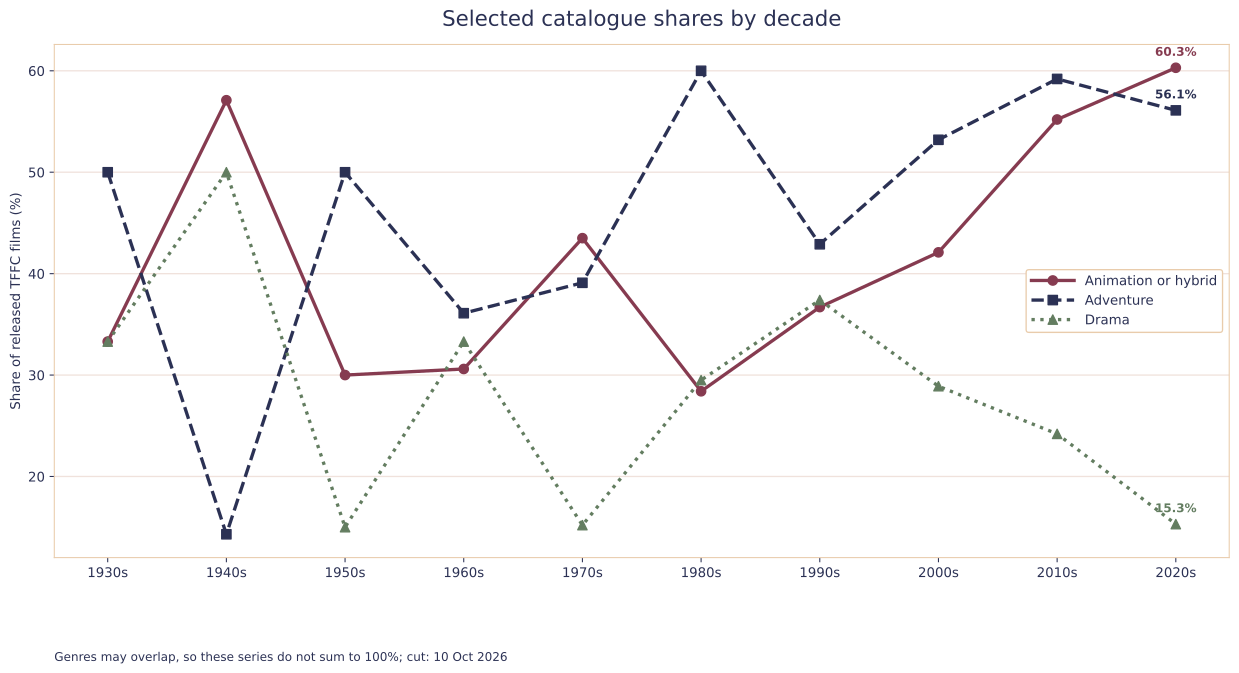
Across 1,229 released films in The Family Film Collection, the balance of format and genre looks very different in the 2020s than it did in the 1990s. Animation occupies a larger share, adventure and fantasy are more prominent, and drama accounts for a smaller part of the catalogue.
Family cinema does not move in a straight line. Each decade contains revivals, outliers, experiments and films that resist the dominant pattern. But when a catalogue stretches from 1935 to 2026, broad changes become visible.
For this analysis, TFFC used the 1,229 films that had been released by 10 October 2026. The aim is not to describe every family film ever made. TFFC is a curated catalogue, so these figures describe the collection itself. They are useful for seeing how the kinds of films represented in a long-running family-film library have shifted across time.
Animation takes a larger share
In the 1990s, films classified by TFFC as animation or hybrid made up 36.7% of the released catalogue from that decade. In the 2020s, the share is 60.3%.
That broad group includes CGI animation, hand-drawn animation, anime, stop motion, motion capture and hybrid productions. It should not be read as a single-technique trend. The specialist animation study looks more closely at how CGI became the dominant primary technique and how other forms changed alongside it.
The broader point here is simpler: animated and hybrid films occupy much more of TFFC’s newer-decade catalogue than they did in the 1990s.
Adventure becomes more prominent
Adventure rises from 42.9% of 1990s films in the released catalogue to 56.1% in the 2020s.
The increase does not mean that one uniform kind of adventure took over. The tag spans fantasy quests, survival stories, historical journeys, superhero films, science-fiction missions, family expeditions and smaller stories built around discovery. It does show that movement, danger, exploration and goal-driven storytelling are represented more heavily in the newer catalogue.
Fantasy also rises across the same comparison, from 32.0% in the 1990s to 43.5% in the 2020s. The path between those points is uneven, so the data does not support a neat story of uninterrupted growth. The 2020s do, however, contain a substantially larger fantasy share than the 1990s.
Drama occupies less of the newer catalogue
The strongest change in the opposite direction is Drama.
In the 1990s, 37.4% of released TFFC films carried the Drama genre tag. In the 2020s, that figure is 15.3%.
This does not mean newer family films stopped dealing with grief, identity, conflict, belonging or difficult relationships. Genre and theme are different layers of description. A film can carry serious material while being classified primarily as adventure, fantasy, animation, comedy or action.
That distinction matters. A declining Drama tag should not be translated into a claim that newer stories became less serious.
The 1990s are not a universal baseline
The decade comparison is useful, but the 1990s should not be treated as a neutral “before” state. Other TFFC studies show that the decade has distinctive features of its own. Short family features, for example, were much more common then than in the 2020s.
The longer view is therefore more useful than a simple old-versus-new contrast. Across the 1980s, 1990s, 2000s, 2010s and 2020s, the proportions move at different speeds. Some shifts accelerate; others reverse or flatten.
The catalogue records change, not a single story of progress or decline.
What this does — and does not — mean
This analysis can support statements about the released TFFC catalogue. It can show how the mix of formats and genre tags changes across decades inside that catalogue.
It cannot, by itself, establish the market share of every family film released worldwide. It also cannot explain why a trend happened. Technology, studio strategy, distribution, audience demand, international production and franchise economics may all matter, but causal explanations require separate evidence.
The value of the catalogue is in its consistency: the same editorial system can be used to compare a large body of family films across a long period, then test more specific questions one by one.
At a glance
- 1,229 released films in the analysis.
- Animation/Hybrid: 36.7% in the 1990s → 60.3% in the 2020s.
- Drama: 37.4% → 15.3%.
- Adventure: 42.9% → 56.1%.
- Fantasy: 32.0% → 43.5%.
How we measured this
Dataset: The Family Film Collection production database, frozen 10 October 2026.
Films examined: 1,229 films released by the freeze date.
Method: Decade-level shares were calculated from TFFC format and genre classifications. Animation/Hybrid in this synthesis means all released records not classified as Live Action, covering the catalogue’s animated and hybrid format categories.
Limitation: TFFC is a curated family-film catalogue, not a census of all films released in each decade. The figures describe this catalogue and should not be presented as total-market prevalence.
Continue exploring
- Are Family Movies Getting Longer? (R01)
- How CGI Became the Dominant Technique in Family Animation (R02)
- Where Did the G Rating Go? (R04)
- Family Movies Are Much More Likely to Continue an Existing Screen Series (R06)
- What Happened to “Good vs Evil” in Family Movies? (R08)
- What Share of Family Cinema Comes from Books? (R15)


