
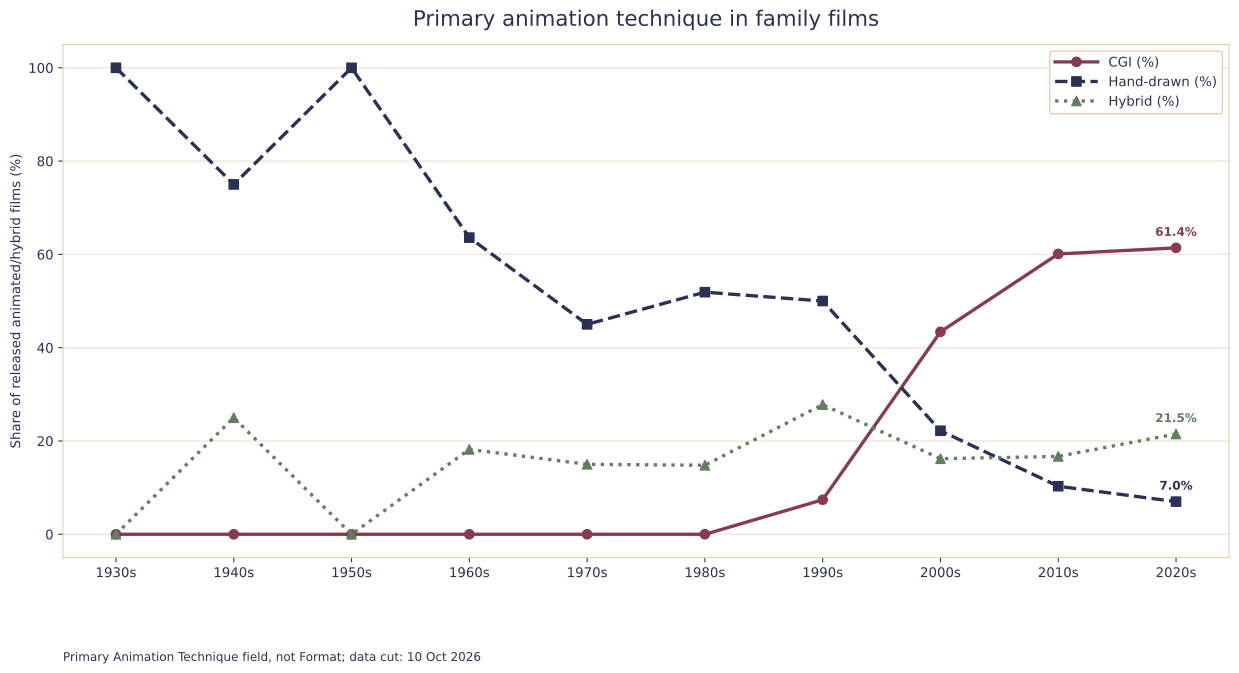
In TFFC’s released animated and hybrid catalogue, CGI rises from 7.4% of primary animation-technique classifications in the 1990s to 61.4% in the 2020s through 10 October 2026. Over the same comparison, the primary Hand-drawn classification falls from 50.0% to 7.0%.
The shift is large enough to see without a complicated model. What needs care is the meaning of the categories.
TFFC stores a primary Animation Technique for each animated or hybrid film. The analysis covers 588 released films, all with a populated primary-technique field. A primary label is a classification tool: it identifies the dominant technique used for catalogue organization. It does not attempt to list every visual method present in a film.
The 1990s start from a very different mix
Among the 54 released animated/hybrid films from the 1990s in this cohort, 50.0% carry TFFC’s primary Hand-drawn classification. CGI accounts for 7.4%, while Hybrid accounts for 27.8%.
By the 2000s, CGI rises to 43.4% of the 99-film decade cohort. Hand-drawn falls to 22.2%, while Hybrid sits at 16.2%.
The 2010s push the CGI share higher again: 60.1% of 203 films. The primary Hand-drawn classification drops to 10.3%.
In the 2020s through the freeze date, CGI accounts for 61.4% of 158 released animated/hybrid films, Hand-drawn for 7.0%, and Hybrid for 21.5%.
“Primary technique” is the key phrase
A film classified as Hybrid may contain substantial hand-drawn or CGI work. Anime is also kept as a separate primary category in TFFC’s taxonomy. Stop motion and motion capture have their own classifications as well.
That means 7.0% Hand-drawn does not mean only 7.0% of newer animation contains any hand-drawn material. It means 7.0% of the 2020s cohort receives Hand-drawn as its primary TFFC technique.
The same caution applies to CGI. Its 61.4% share identifies primary classification, not the total presence of digital tools across production pipelines.
Hybrid is still substantial
The headline change is not a story in which every non-CGI technique disappears. Hybrid accounts for a substantial 21.5% of the 2020s cohort.
That category captures films whose visual identity is built across more than one production mode. Its presence is a useful reminder that animation history is not only a replacement sequence from hand-drawn to CGI. Newer family animation contains a large CGI center, but also mixed techniques, anime, stop motion and other approaches.
What the catalogue shows
The descriptive finding is strong: CGI became the dominant primary technique in newer TFFC family animation.
The data does not identify one reason. Technology, studio investment, production workflows, audience expectations, international animation and distribution all can shape the mix. Those questions need separate historical and industry evidence.
The TFFC catalogue is most useful here as a consistent classification system applied across decades. It shows how the balance of primary techniques represented in the family-film library changed.
At a glance
- Released animated/hybrid analytical cohort: 588 films.
- CGI: 7.4% in the 1990s → 61.4% in the 2020s.
- Primary Hand-drawn: 50.0% → 7.0%.
- Hybrid: 27.8% → 21.5%.
- Every film in the cohort has a populated primary Animation Technique.
How we measured this
Dataset: The Family Film Collection production database, frozen 10 October 2026.
Films examined: 588 released films classified in TFFC’s animated/hybrid formats.
Method: The primary Animation Technique field was summarized by decade. For the main visual, smaller primary categories can be grouped as “Other Primary Techniques” while the article keeps the underlying taxonomy explicit.
Limitation: Primary technique is not an inventory of every technique present in a film. Anime and Hybrid are separate primary classifications, so Hand-drawn should not be interpreted as total hand-drawn presence.
Continue exploring
- 90 Years of Family Movies: How the Mix Changed (R03)
- Eras
- Animation collections
- Studios


