
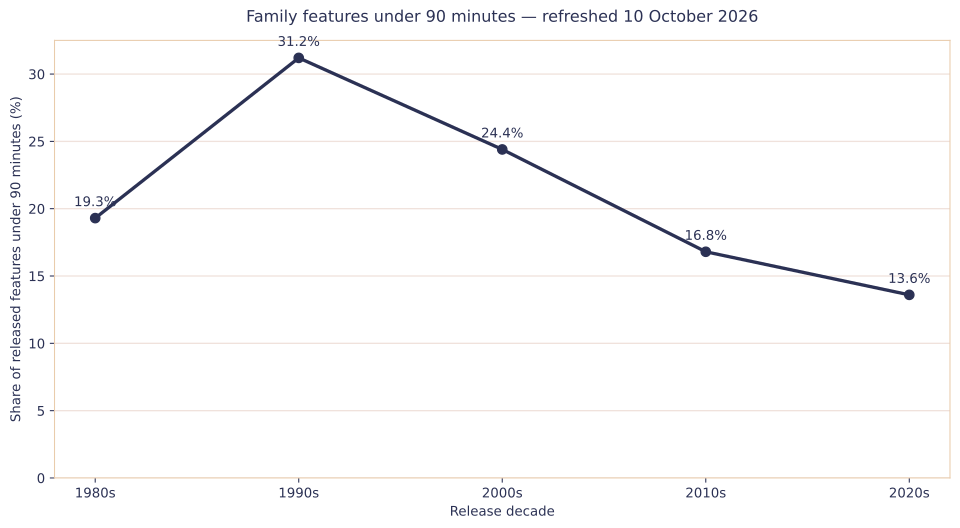
Not in a simple straight line. Across 1,132 released feature-length films in The Family Film Collection, the clearer change is that short family features have become much less common. Films under 90 minutes account for 31.2% of the 1990s cohort, but only 13.6% of the 2020s cohort through 10 October 2026.
Averages can make runtime look simpler than it is. If one number rises, it is tempting to describe every decade as another step toward longer films. TFFC’s data does not support that story.
For this analysis, we included released films with runtimes of 60 minutes or more. That produces a feature-length analytical cohort of 1,132 films. Shorter specials and short-format titles are valid TFFC records, but this runtime comparison excludes them.
The 1990s stand out for short features
The 1990s have the lowest average runtime among the five recent decades in this study: 98.9 minutes. Their median is 97.5 minutes, and 31.2% of the films run for less than 90 minutes.
The 2000s look different. Average runtime rises to 104.7 minutes, while the median holds at 98. The under-90 share falls to 24.4%.
By the 2010s, the median reaches 102 minutes and only 16.8% of films are under 90 minutes. In the 2020s through the freeze date, the median is 102 minutes, the average is 106.7, and the under-90 share is 13.6%.
That is a large contraction in the short-feature end of the distribution.
The trend is not a staircase
The 1980s are the reason a simple “movies get longer every decade” headline fails. Their average runtime is 104.5 minutes, almost identical to the 2000s, and their median is 101.5 minutes.
The data therefore looks less like a steady upward staircase and more like a dip in the 1990s followed by a sustained reduction in shorter features.
That distinction matters. Averages and medians in the 2020s are higher than in the 1990s, but the strongest visible change is the lower probability of encountering an 80- or 85-minute family feature.
Animation shows the short-feature shift clearly
The same direction appears inside TFFC’s Animation/Hybrid group.
In the 1990s, 58.8% of Animation/Hybrid features in the analytical cohort run for less than 90 minutes. In the 2020s, the share is 18.9%.
This format check matters because the main result is not being produced only by longer live-action blockbusters. Short animated and hybrid features are also much less common in the newer catalogue.
Live action moves in the same broad direction through a different measure. Average runtime rises from 104.9 minutes in the 1990s to 114.2 minutes in the 2020s.
What families may notice
A ten- or fifteen-minute runtime difference can matter in practical family viewing. It can change whether a film fits before bedtime, whether a younger viewer can comfortably stay with a full story, or whether a family has room for pauses.
But runtime is not a proxy for suitability. A 78-minute film can be intense, and a two-hour film can be straightforward for an older child. TFFC treats runtime as one planning dimension alongside age guidance, sensory profile, frightening content, conflict and subject matter.
The research finding is about availability of shorter feature-length options, not a claim that short films are better for children.
What this study can and cannot say
The analysis describes the released TFFC catalogue. It does not establish the average runtime of every family film released worldwide in each decade.
It also does not identify a cause. Production economics, franchise strategy, theatrical expectations, streaming, genre composition and changes in animation all may contribute, but those explanations require evidence beyond the runtime field itself.
What the TFFC data can say with confidence is narrower: the 1990s contain many more short family features, and films under 90 minutes are far less common in the newer catalogue.
At a glance
- Feature-length analytical cohort: 1,132 released films.
- 1990s average / median: 98.9 / 97.5 minutes.
- 2020s average / median: 106.7 / 102 minutes.
- Under 90 minutes: 31.2% in the 1990s → 13.6% in the 2020s.
- Animation/Hybrid under 90: 58.8% → 18.9%.
- Live Action average runtime: 104.9 → 114.2 minutes.
How we measured this
Dataset: The Family Film Collection production database, frozen 10 October 2026.
Films examined: Released films with runtime ≥60 minutes.
Method: Runtime distributions were compared by decade using average, median and the share below 90 minutes. Format-level checks were used to test whether the result depended only on one broad format group.
Runtime provenance: All 25 new records previously missing a duration were checked against independent film or distributor references. For A Muppets Christmas: Letters to Santa, the original 45-minute broadcast edition is the reference version; longer home-video/aggregator durations exist. Source URLs and version caveats are supplied in the accompanying evidence table. No values were written to the Production Master.
Limitation: TFFC is a curated catalogue, not a census of all family-film releases. Sub-60-minute records are valid catalogue entries but intentionally excluded from this feature-length analysis.


