
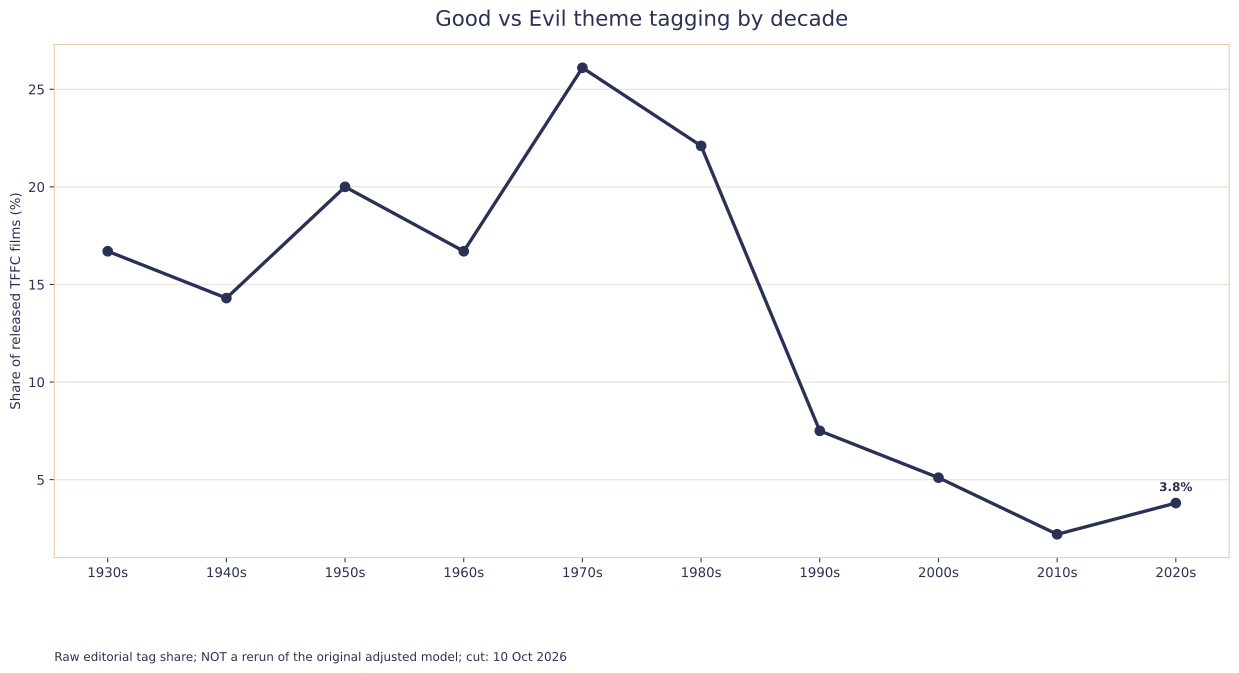
The TFFC Good vs Evil theme tag appears on 22.1% of released films from the 1980s, 7.5% from the 1990s and 3.8% from the 2020s. The decline is clear. Interpreting what replaced it is more complicated because TFFC’s newer films carry more theme tags on average.
Theme data can produce dramatic stories very quickly. If one label falls and another rises, it is tempting to describe a cultural shift in a single sentence.
That is not how this study is used.
TFFC’s Themes & Values fields are editorial metadata. They are designed to help families discover connections between films, not to function as a direct psychological measure of story complexity. A film can carry several themes, and the average number of theme tags is not constant across decades.
“Good vs Evil” becomes much less common
The most robust descriptive result is the decline of the Good vs Evil tag itself.
- 1980s: 22.1%.
- 1990s: 7.5%.
- 2000s: 5.1%.
- 2010s: 2.2%.
- 2020s through 10 Oct 2026: 3.8%.
The 2020s show a small rise from the 2010s, so the path is not perfectly linear. The longer comparison is still clear: the tag occupies a much smaller share of newer TFFC films than of the 1980s cohort.
Why raw theme growth can mislead
If newer films receive more theme tags per title, many individual themes can appear to become more common although the underlying storytelling mix may not have changed by the same amount.
That is why this research does not headline raw growth in broad labels such as Friendship, Family or Loyalty. Their counts need to be interpreted alongside changes in tagging density and format composition.
To test whether that compositional difference distorted the pattern, theme direction was checked after standardizing for format and theme-tag-density composition.
Version note: The percentages above have been refreshed against the 1,229 released-film catalogue as of 10 October 2026. The format/tag-density standardized directional analysis that follows is an archived result from the 30 September cohort, not a new adjusted estimate for 1,229 films.
Some directional signals survive the adjustment
After that standardization, several themes continued to show a directional signal.
Higher in newer composition: Acceptance, Teamwork, Love and Grief.
Lower in newer composition: Community, Growing Up, Justice and Self-Discovery.
These are not rankings of which themes “matter more”, and they do not mean a film in one decade lacks the themes associated with another. They are catalogue-level directional signals after a specific adjustment.
The result is most useful as a map for closer editorial research: which ideas appear in different combinations, which genres carry them, and how their framing changes across films.
Less “Good vs Evil” does not mean more complex
A binary moral-conflict tag can become less frequent for many reasons. Villains may be written differently. Conflicts may become interpersonal, institutional, internal or environmental. A film may also contain clear moral opposition without receiving the exact TFFC tag.
The database does not provide a valid numerical scale of “narrative complexity”. It would therefore be wrong to convert the trend into “old family films were simple and modern family films are complex.”
The publishable finding is narrower: TFFC uses the Good vs Evil tag much less frequently in newer-decade films, and some other theme directions persist after accounting for changing tag density and format mix.
At a glance
- Released catalogue: 1,229 films.
- Good vs Evil: 22.1% in the 1980s → 3.8% in the 2020s.
- Lowest decade in the comparison: 2010s, 2.2%.
- Standardized directional signals up: Acceptance, Teamwork, Love, Grief.
- Standardized directional signals down: Community, Growing Up, Justice, Self-Discovery.
How we measured this
Dataset: The Family Film Collection production database, frozen 10 October 2026.
Films examined: 1,229 released films.
Method: Decade-level theme-tag shares were calculated. Selected broader theme directions were then checked using a standardization for format and theme-tag-density composition.
Limitation: TFFC themes are editorial discovery metadata. They should not be interpreted as direct measures of narrative complexity, cultural values across society or the full film market.
Continue exploring
- 90 Years of Family Movies: How the Mix Changed (R03)
- Themes & Values
- Worlds
- Eras


