Key findings
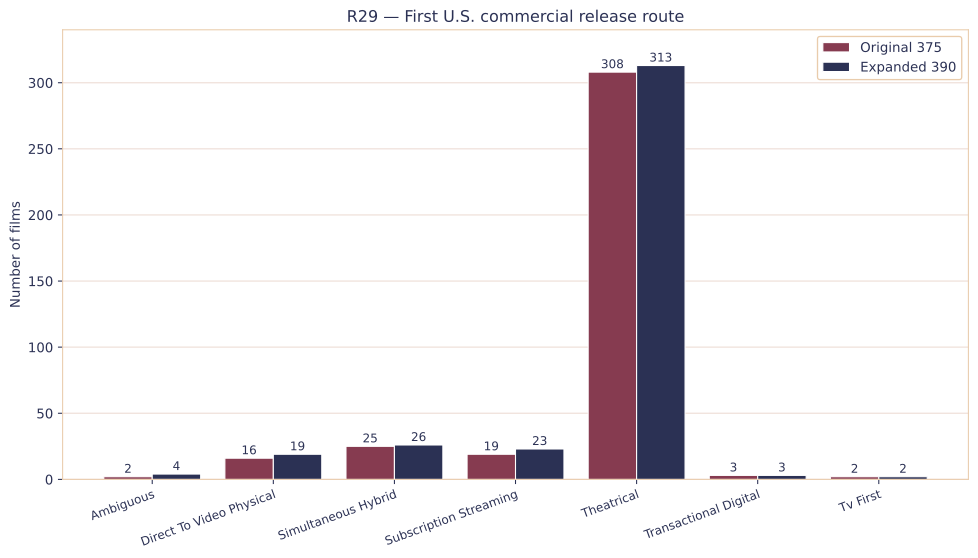
- Theatrical release is the dominant route across the full study: 308/375 films (82.1%) were theatrical-first in the United States.
- Before the pandemic-era break, theatrical dominance was much stronger: 255/278 films through 2019 (91.7%) were theatrical-first.
- 2020–2021 produced the sharpest route disruption in the dataset: 8/31 (25.8%) were theatrical-first; 12/31 (38.7%) were simultaneous hybrid; 9/31 (29.0%) were subscription-streaming-first; and 2/31 (6.5%) were transactional-digital-first.
- The post-2021 period does not return to the old 90%+ theatrical baseline: 45/64 films from 2022–2026 (70.3%) were theatrical-first, while 19/64 (29.7%) first reached U.S. audiences through subscription streaming or a theatrical/streaming hybrid.
- That post-2021 diversification survives the COVID sensitivity test: after removing COVID-flagged titles, 45/62 (72.6%) are theatrical-first and 17/62 (27.4%) are subscription-streaming-first or simultaneous theatrical/streaming hybrids.
- Physical-home-video-first release was a distinct earlier phase: 16/375 films (4.3%) used that route, with 9/76 films in the 2000s (11.8%). The last example in this frozen core sample is from 2015.
- Physical-first does not equal “franchise sequel”: only 6/16 physical-first titles (37.5%) are franchise entries; 10/16 (62.5%) are standalone titles, including imported animation whose first meaningful U.S. commercial access came on home video.
- Modern hybrid release is overwhelmingly tied to subscription streaming: 21/25 hybrids (84.0%) combine theatrical and subscription-streaming access. Every post-2021 hybrid in the sample — 12/12 — is theatrical + subscription streaming within the seven-day rule.
For most of the history represented in this study, asking where a family animated film first reached a general U.S. audience had a simple answer: the cinema.
Across TFFC’s frozen research sample of 375 qualifying animated features, 308 films — 82.1% — were theatrical-first. That headline already shows the strength of the cinema model, but it actually understates how dominant theatrical release was for most of the period. Through 2019, 255 of 278 films with resolved routes — 91.7% — first entered the U.S. commercial market through theatres.
The important change, then, is not that streaming suddenly replaced cinemas. The data show something more specific: family animation moved from a system with one overwhelmingly dominant release route to a system in which several routes can now function as meaningful first access.
The theatrical model held for decades
The long-run pattern is striking. Through 1999, 59 of 64 dated films in the study — 92.2% — were theatrical-first. In the 2000s, the share was 67 of 76 — 88.2%. From 2010 through 2017, it climbed to 101 of 107 — 94.4%.
That stability matters because it establishes the baseline. Alternative routes existed, but they did not yet form a broad competing system for first release.
Television-first animation appears only twice in the core census. Physical home video becomes more visible from the late 1990s into the 2000s. A transactional-digital first release appears in 2017. Subscription streaming first appears in this sample in 2018.
The release system was beginning to diversify before 2020, but the cinema still dominated. Netflix’s February 2018 acquisition announcement for White Fang stated that the film would launch on Netflix in the United States that year, providing contemporary platform evidence that subscription-first family-animation distribution predated COVID-19.2
Home video created an earlier alternative lane
Before streaming became a major first-release route, physical home video had already shown that family animation could reach U.S. audiences without a standard theatrical opening.
Sixteen of 375 films — 4.3% — are physical-home-video-first in the United States. The route is most visible in the 2000s, when 9 of 76 films — 11.8% — entered the U.S. market this way.
This group needs careful interpretation. A U.S. physical-first classification is a distribution fact, not a judgment about the film’s production status or quality. It also does not mean every title belongs to the familiar direct-to-video sequel model.
Only 6 of the 16 physical-first films in the core sample are franchise entries. Ten are standalone titles. Several are imported animated films whose U.S. commercial history differed from their original-market release history.
The franchise signal is real but concentrated. Five of the six franchise physical-first entries arrived between 1998 and 2005. In this dataset, the home-video-first route is best understood as a mixed historical lane: part franchise extension, part U.S. distribution route for films that had already existed elsewhere.
That distinction prevents two different histories from being collapsed into a single “direct-to-video” story.
Streaming was visible before the pandemic
The next transition begins before COVID-19.
From 2018 to 2019, 28 of 31 films — 90.3% — were still theatrical-first. But three films — 9.7% — were subscription-streaming-first. The change was still small, yet the route itself had become established in the sample.
This matters when reading the years that followed. The pandemic did not invent streaming-first family animation. It hit an industry in which subscription platforms had already become a viable first-release destination for some animated features.
“Physical home video and streaming belong to different distribution eras: one peaks in the 2000s; the other becomes structurally visible from 2018 onward.”
2020–2021 broke the old distribution pattern
The sharpest change in the entire census comes in 2020–2021.
Among 31 films in those two years:
- 8/31 (25.8%) were theatrical-first;
- 12/31 (38.7%) were simultaneous hybrid;
- 9/31 (29.0%) were subscription-streaming-first;
- 2/31 (6.5%) were transactional-digital-first.
Sixteen of those 31 films carry the study’s COVID exception flag.
That is why the period cannot be treated as a normal market comparison. Cinema closures, delayed releases, shortened windows, PVOD experiments and platform strategies overlapped. The Motion Picture Association’s 2020 THEME Report described theaters as shuttered around the world and characterized the crisis as accelerating distribution changes that were already under way.3 Disney’s official release history for Soul documents its move to a Disney+ debut on December 25, 2020, while Comcast’s corporate archive records Trolls World Tour as a premium-video-on-demand release made while many cinemas were closed.45 A route used in 2020 or 2021 may reflect emergency conditions, an existing platform plan, or both.
The sensitivity test helps separate those forces. Once COVID-flagged titles are removed, 15 films remain from 2020–2021. Of those, 5/15 (33.3%) are theatrical-first, 6/15 (40.0%) are subscription-streaming-first, 3/15 (20.0%) are simultaneous hybrid, and 1/15 (6.7%) is transactional-digital-first.
So COVID explains a large part of the disruption, but not all of it. The non-flagged titles from those years also show a release environment that had already moved beyond the older theatrical-default model.
Day-and-date family releases became a real 2021 route
The simultaneous-hybrid category is not only a coding construct. Universal and Peacock announced The Boss Baby: Family Business for a July 2, 2021 day-and-date theatrical and Peacock release, while Paramount+ announced that PAW Patrol: The Movie would premiere on the service on August 20, 2021, the same day it opened in theaters.67
Those cases show how two commercially meaningful first-access routes could be designed to begin together for family animation.
After 2021, cinemas recover — but the old baseline does not
The strongest evidence against a simple “pandemic anomaly” explanation appears after the emergency period.
From 2022 through September 25, 2026, 45 of 64 films — 70.3% — are theatrical-first. That is a substantial recovery from 2020–2021.
It is also far below the pre-2020 baseline of 91.7%.
The remaining 19 of 64 films — 29.7% — are split between subscription-streaming-first releases and simultaneous hybrids. Seven are subscription-streaming-first; twelve are hybrid.
Removing the two COVID-flagged films in this later period barely changes the picture. Among the remaining 62 titles, 45 — 72.6% — are theatrical-first, while 17 — 27.4% — involve subscription streaming as either the first route or part of a simultaneous theatrical/streaming release.
That is the clearest sign of structural change in the R29 census. The extreme 2020–2021 distribution mix was temporary. A more diversified release system was not. By December 2021, NBCUniversal was publicly setting out a 2022 model in which most Universal-group films could reach Peacock as early as 45 days after theatrical release, showing that window redesign had become part of post-emergency distribution planning.8
“The pandemic created the sharpest break, but the post-2021 data do not return to the old 90%+ theatrical baseline.”
“Hybrid” now mostly means theatrical + subscription streaming
The hybrid category is especially revealing.
R29 uses a fixed rule: two qualifying commercial routes count as simultaneous when they begin within seven calendar days in the United States.
Across the full dataset, 25 films meet that definition. Twenty-one of those 25 — 84.0% — combine theatrical access with subscription streaming.
The pattern becomes cleaner after 2021. All 12 hybrid films from 2022–2026 are theatrical + subscription streaming.
This is different from treating hybrid release as a synonym for pandemic-era PVOD. In the later sample, the hybrid route is primarily a relationship between theatres and subscription platforms.
That points to a changed role for theatrical release in some cases. A cinema opening can still matter without functioning as the sole first window. Theatrical exhibition and home subscription access can operate almost side by side.
Route diversification is not mainly a franchise phenomenon
Franchise expansion is commonly associated with alternative distribution, especially when discussing direct-to-video sequels or platform extensions. The R29 data do not support reducing the broader release-route shift to franchise strategy.
Among the 65 resolved films that are not theatrical-first, 46 — 70.8% — are standalone titles and 19 — 29.2% — are franchise titles.
The overall core sample is also weighted toward standalone films, so those raw counts should not be read as a causal franchise comparison. But they make one point clear: non-theatrical and hybrid first release is not confined to franchise content.
The shift affects original films, imports, franchise entries and platform-backed animation alike.
What changed — and what did not
The historical sequence in this sample is not one straight line from cinema to streaming.
It looks more like four overlapping phases:
- Long theatrical dominance. Through 2019, more than nine in ten films in the resolved sample are theatrical-first.
- A physical-home-video alternative. Most visible from the late 1990s through the 2000s, with a mix of franchise extensions and imported standalone animation.
- The arrival of digital-first distribution. Transactional digital appears in 2017; subscription-streaming-first releases appear in 2018.
- A mixed 2020s system. The pandemic produces the sharpest break, but the years after 2021 settle into a pattern where theatrical release is again the majority route without regaining its earlier near-monopoly.
The result is not the disappearance of cinemas. It is the disappearance of the assumption that a major family animated feature has only one obvious way to reach U.S. audiences first.
What this study can and cannot show
R29 measures first meaningful commercial release route in the United States. It does not measure box-office success, total viewership, profitability, production quality or which route was strategically “better.”
Festival, market and awards-qualification screenings do not automatically count as commercial release. Transactional digital and subscription streaming remain separate. A hybrid classification requires qualifying routes to begin within seven calendar days.
The headline sample contains 375 core animated features. A separate 107-title hybrid-production-format cohort is preserved as a boundary group and is not mixed into the headline denominator. Nineteen other seed rows are documented feature-level exclusions. Two core titles remain AMBIGUOUS because available evidence did not establish a reliable U.S. first commercial route.
The 2026 data are partial through September 25, 2026.
Most importantly, this is a curated TFFC research sample, not a census of every animated feature released in the United States. Percentages describe this frozen study sample and should not be presented as market-share estimates for the entire animation industry.
Conclusion
Family animation’s U.S. release history is still primarily a theatrical story. Across the full R29 sample, 308 of 375 films — 82.1% — are theatrical-first.
But the long-run average hides the change that matters most.
Through 2019, theatrical release accounted for 255 of 278 films — 91.7%. In the post-emergency 2022–2026 period, it accounts for 45 of 64 — 70.3%. After removing COVID-flagged cases, more than a quarter of the later sample reaches audiences through subscription streaming first or through a near-simultaneous theatrical/streaming model.
The evidence therefore points to neither a total streaming takeover nor a full return to the old theatrical window. It shows a new distribution landscape in which cinemas remain central, but no longer hold the same near-exclusive position at the start of a family animated film’s U.S. commercial life.
10 October 2026 — Updated first-release-route census
The original R29 core study includes 375 films. Fifteen further qualifying animation features expand the current TFFC research cohort to 390. By first meaningful U.S. commercial access, this expanded cohort contains 313 theatrical (80.3%), 26 simultaneous hybrid (6.7%), 23 subscription-streaming first (5.9%), 19 physical-home-video first (4.9%), 3 transactional digital (0.8%), 2 TV-first (0.5%) and 4 ambiguous (1.0%). The ambiguity category includes the two historical cases plus Niko: Beyond the Northern Lights and Rudolph and Frosty’s Christmas in July. The update applies R29’s separate territory, festival and seven-calendar-day simultaneity rules. This is the expanded curated TFFC cohort, not the full U.S. release market.
FAQs
Did streaming replace theatrical release for family animation?
No. In the 2022–2026 sample, 45/64 films (70.3%) are still theatrical-first. The change is that streaming and hybrid release now form a substantial parallel lane: 19/64 (29.7%) are subscription-streaming-first or simultaneous hybrids.
Was the shift only caused by COVID-19?
No. COVID-19 produced the sharpest disruption, which is why the study flags those cases separately. But after COVID-flagged titles are removed from 2022–2026, 17/62 films (27.4%) still use subscription streaming as the first route or as part of a simultaneous theatrical/streaming release.
Does physical-home-video-first mean a film was a direct-to-video sequel?
No. Only 6/16 physical-first titles in the core sample are franchise entries. Ten are standalone films, including imported animation whose first meaningful U.S. commercial release happened on physical home video.
Looking for reliable findings to cite?
Each study brings its main findings together with the date, method and sources. Readers and journalists can check the context before using the results.
Methodology box
- Films examined
- 375 qualifying core animated features from the frozen TFFC R29 sample.
- Territory
- United States.
- Measure
- First meaningful general commercial release route.
- Routes
- Theatrical; direct-to-video physical; TV first; transactional digital; subscription streaming; simultaneous hybrid; ambiguous.
- Hybrid rule
- qualifying routes begin within seven calendar days.
- Festival rule
- festival, market or awards screenings do not count by default as general commercial release.
- COVID treatment
- separate exception flag used for sensitivity analysis.
- Boundary group
- 107 hybrid-production-format titles preserved separately.
- Unresolved
- 2/375 core titles remain ambiguous.
- 2026 cutoff
- September 25, 2026.
Cite this research
The Family Film Collection. “How Family Animation Changed Its First Release Route.” TFFC Research & Insights, R29, 2026.
Primary research asset: film-level U.S. commercial release-route census, 375-film frozen core sample.
Notes and sources
-
TFFC R29 film-level commercial release-route census, frozen October 2, 2026. Core sample: 375 qualifying animated features; primary territory: United States; simultaneous-hybrid window: seven calendar days. The final research workbook and analysis-ready CSV are the primary authority assets for every R29 count, percentage and title classification. ↩
-
Netflix, “Netflix has acquired Superprod, Bidibul Productions and Big Beach’s White Fang”, February 21, 2018. https://about.netflix.com/en/news/netflix-has-acquired-superprod-bidibul-productions-and-big-beachs-white-fang-directed-by-academy-award-winner-alexandre-espigares ↩
-
Motion Picture Association, 2020 THEME Report, March 18, 2021. https://www.motionpictures.org/research-docs/2020-theme-report/ ↩
-
The Walt Disney Company, “New Trailer Debuts for Disney and Pixar’s ‘Soul,’ Coming to Disney+ on December 25”, October 14, 2020. https://thewaltdisneycompany.com/news/new-trailer-debuts-for-disney-and-pixars-soul-coming-to-disney-on-december-25/ ↩
-
Comcast, Company Timeline, 2020 entry on Trolls World Tour and premium video on demand. https://corporate.comcast.com/press/timeline ↩
-
Comcast / Peacock, “The Boss Baby: Family Business Will Premiere on Peacock Day-and-Date With Theaters”, May 24, 2021. https://corporate.comcast.com/press/releases/dreamworks-animations-boss-baby-family-business-premiere-peacock ↩
-
Paramount Press Express, “It’s a ‘Pawsome’ Summer on Paramount+”, June 15, 2021. https://www.paramountpressexpress.com/paramount-plus/releases/?view=57803 ↩
-
Comcast / Peacock, “Universal Filmed Entertainment Group Content Will Debut on Peacock as Early as 45 Days Following Theatrical Release”, December 9, 2021. https://corporate.comcast.com/press/releases/peacock-universal-filmed-entertainment-group-debut-on-peacock-theatrical-release ↩