
In TFFC’s frozen catalogue, 35 of 936 films with a complete five-year follow-up window — 3.7% — generated a qualifying TV or streaming series within five years under a strict, high-confidence Film→TV rule. Including strong mixed-provenance cases raises the result to 4.2%.
A film and a television series can share a title, character or franchise without the film having generated the series. A book may be adapted separately for cinema and television. A television property may produce a film rather than the other way around. A later sequel can also sit closer in time to a series even though an earlier film is the true screen origin.
Those distinctions make “how many movies became TV shows?” less straightforward than a franchise list suggests.
For R28, TFFC froze a set of 1,088 released films, adjudicated every Film↔TV relation in the existing production-link seed, then ran independent discovery to find film-derived series that the production table had missed.
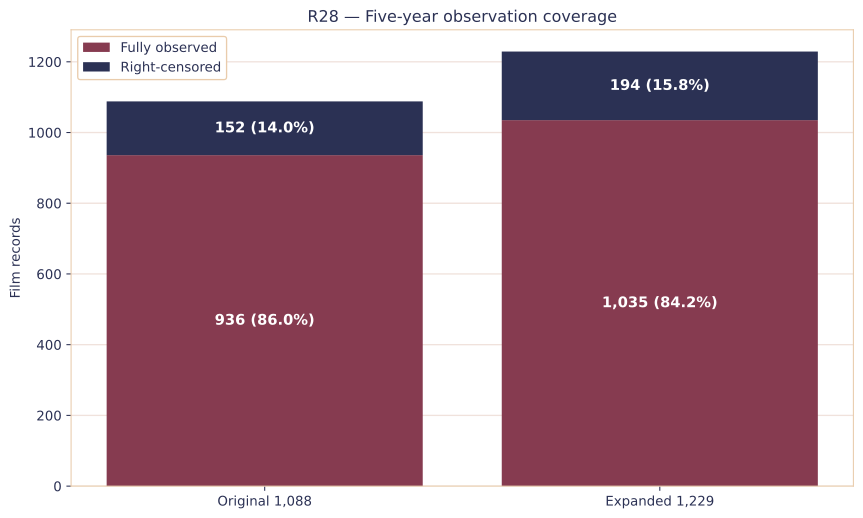
The comparable five-year cohort contains 936 films
The main difficulty is time. A film released in 2024 has not had the same opportunity to generate a series as a film released in 1994. Counting recent films as non-conversions would push the rate down simply because their follow-up window is incomplete.
TFFC therefore uses a fixed five-year outcome. At the 2 October 2026 research freeze, 936 films had at least five full years of observation. The remaining 152 films are right-censored for this comparison and are not treated as failures.
Within those 936 fully observed films, 35 have a HIGH-confidence qualifying Film→TV origin event within five years: 3.74%.
A provenance sensitivity check moves the result only modestly
Some properties have mixed ancestry. A film may have a clearly connected television extension while the characters or story also come from an older book, comic, television segment or other property.
Adding the cases TFFC classified as MEDIUM_HIGH raises the five-year count from 35 to 39 of 936, or 4.17%.
That shift is small enough that the main finding does not depend on a large group of borderline cases.
Episode length is not used as a separate exclusion rule. If an official source identifies a project as a television or streaming series, it can qualify even when the installments are short-form. That rule includes LEGO Frozen Northern Lights, which D23 described as an animated short-form series extending the Frozen property.
The path from film to television takes several forms
Among the 74 HIGH/MEDIUM_HIGH origin films with a documented qualifying television extension in the frozen matched table, the first qualifying relationship is not dominated by one mechanism:
- 26 are other explicitly documented film-origin relationships.
- 22 extend the same continuity or screen world.
- 14 are direct continuations.
- 11 are character or spin-off extensions.
- 1 is a television remake/reboot under the locked coding rule.
The categories are research labels, not value judgments. Their purpose is to stop very different kinds of franchise movement from being collapsed into one vague “adaptation” bucket.
The median first-series lag is about four years — with a long tail
For those 74 HIGH/MEDIUM_HIGH origin films, the median time to the first qualifying series is about 4 years. The middle half runs from roughly 2 to 14 years.
That wide range matters. Some films become television properties quickly. Others are revived decades later. A lifetime Film→TV count therefore answers a different question from the five-year conversion rate.
Where an exact series premiere date was available, TFFC used it. Where only a launch year was securely established, the lag is year-based and should not be read as month-perfect.
The 1990s stand out inside this catalogue
Using the same five-year window, the strict HIGH-confidence rate is 10.1% for the 1990s cohort (14 of 138), compared with 6.0% in the 1980s (5 of 84), 2.3% in the 2000s (5 of 219) and 3.3% in the 2010s (11 of 338).
Those differences are descriptive. They do not show that a decade, studio strategy or technology caused films to move into television. The catalogue composition also changes over time, and the 2020s comparison is only the small fully observed slice through 2 October 2021.
Independent discovery changed the answer
The production database’s existing Film↔TV links were useful starting evidence, but they were not a Film→TV census. Independent discovery found qualifying relations absent from that seed, including Puss in Boots → The Adventures of Puss in Boots and Frozen → LEGO Frozen Northern Lights.
It also prevented false precision around mixed ancestry. The Mr. Peabody & Sherman Show remains in the MEDIUM_HIGH sensitivity tier because DreamWorks framed the series within its feature-film-property strategy while the show also reaches back to the original Jay Ward television property. PBS documentation likewise shows that the Curious George television series was already in production while the 2006 feature was still in pre-production, so that case is not Film→TV. The animated NeverEnding Story series is documented as based on Michael Ende’s book, so it is treated as shared-source-only rather than generated by the 1984 film.
At a glance
- Frozen set of released films: 1,088.
- Fully observed five-year cohort: 936.
- Right-censored recent films: 152.
- Strict HIGH-confidence Film→TV within five years: 35 / 936 = 3.74%.
- HIGH + MEDIUM_HIGH sensitivity: 39 / 936 = 4.17%.
- HIGH/MEDIUM_HIGH documented Film→TV origin films in the frozen matched table: 74.
- Median time to first qualifying series: about 4 years.
How we measured this
Dataset: The Family Film Collection frozen set of released films and the R28 matched Film→Series table, frozen 2 October 2026.
Films examined: 1,088 released films; 936 enter the primary five-year denominator.
Method: Production Film↔TV links were adjudicated as seed evidence, followed by independent discovery and source verification. Each qualifying series receives one research origin film. The headline requires HIGH-confidence Film→TV provenance and a series launch within five years. Official short-form series qualify; episode length alone does not exclude a series.
Limitation: TFFC is a curated catalogue rather than a census of every family-film release. Historical television documentation is uneven, and mixed-source properties can require judgment. The matched table and confidence fields are published so those decisions can be audited.
Continue exploring
- Family Movies Are Much More Likely to Continue an Existing Screen Series (R06)
- How the Mix of Family Cinema Changed Across 90 Years (R03)
- Research & Insights
10 October 2026 — Expanded-catalogue observation window
The R28 source baseline is 1,088 released films, comprising 936 with a full five-year observation window and 152 right-censored at the 2 October 2026 methodological cutoff. Adding the new 141 released films produces 1,229 films. Of the 141 additions, 99 have completed five years and 42 are right-censored, giving 1,035 fully observed and 194 right-censored. The original 35 strict HIGH-confidence and 39 HIGH-or-MEDIUM_HIGH five-year positives retain their frozen meaning. A film receives a new positive only after its television series is independently demonstrated to originate from that film under the R28 one-origin-film rule; the enlarged denominator alone is not a recalculated conversion rate.


